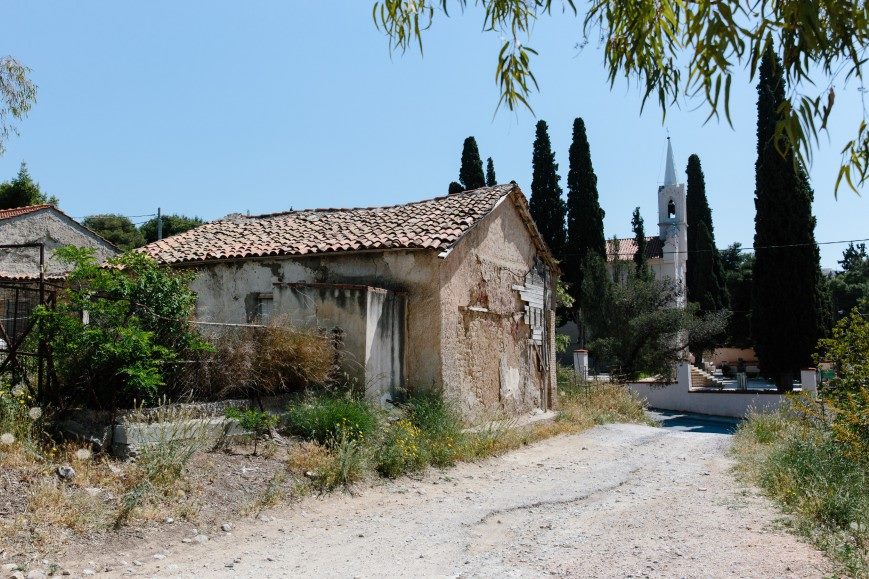
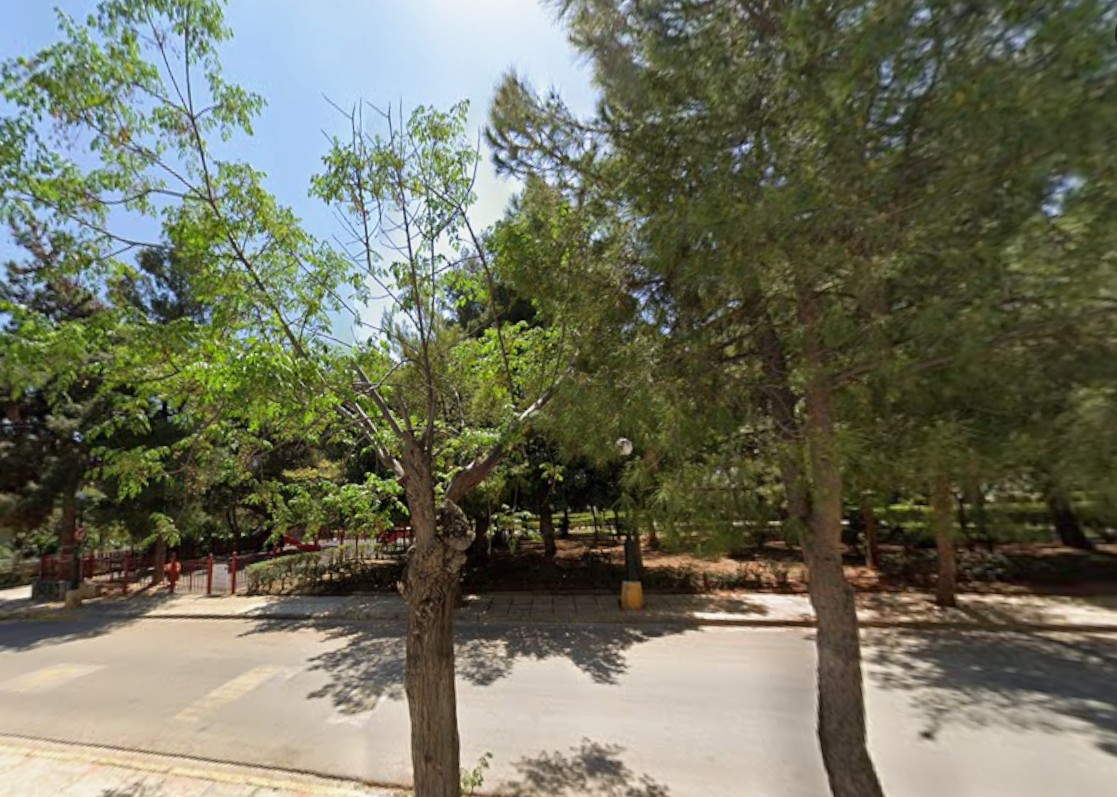
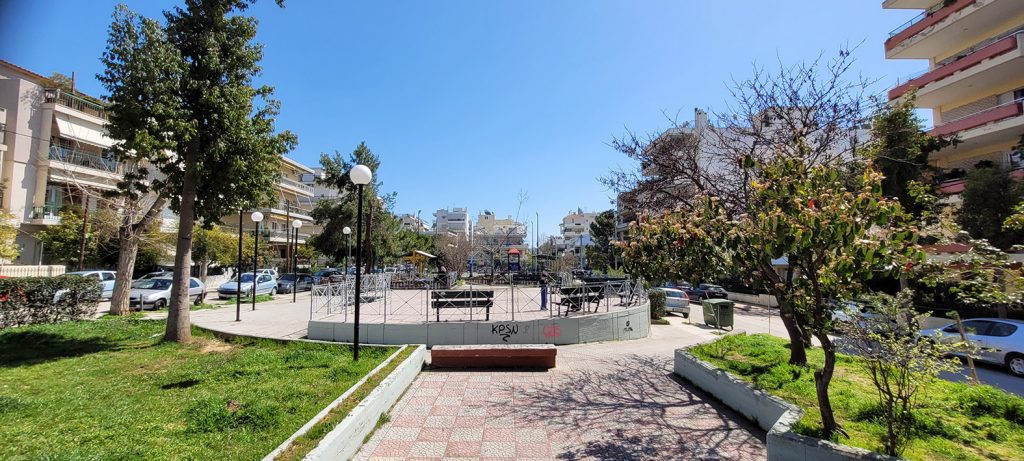
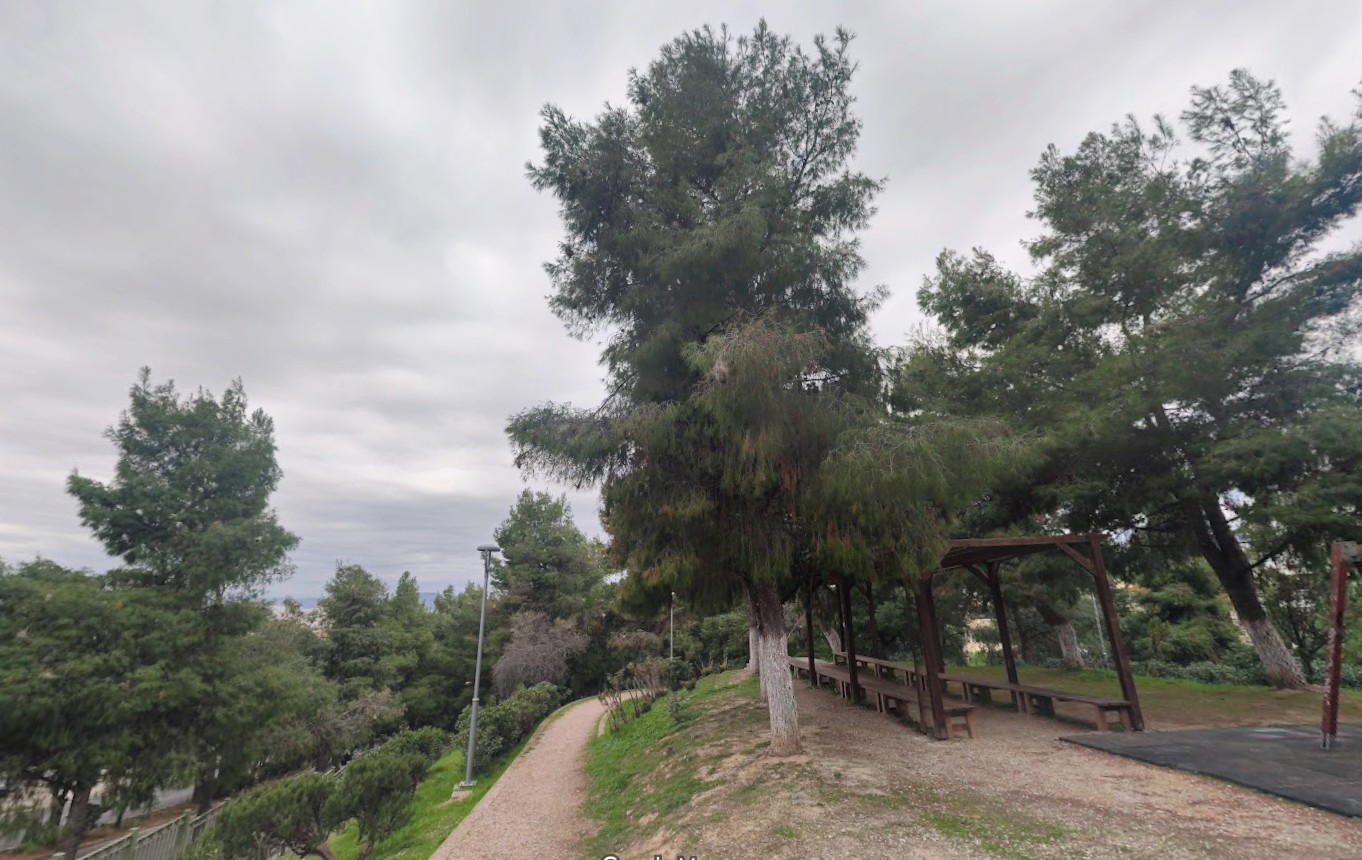
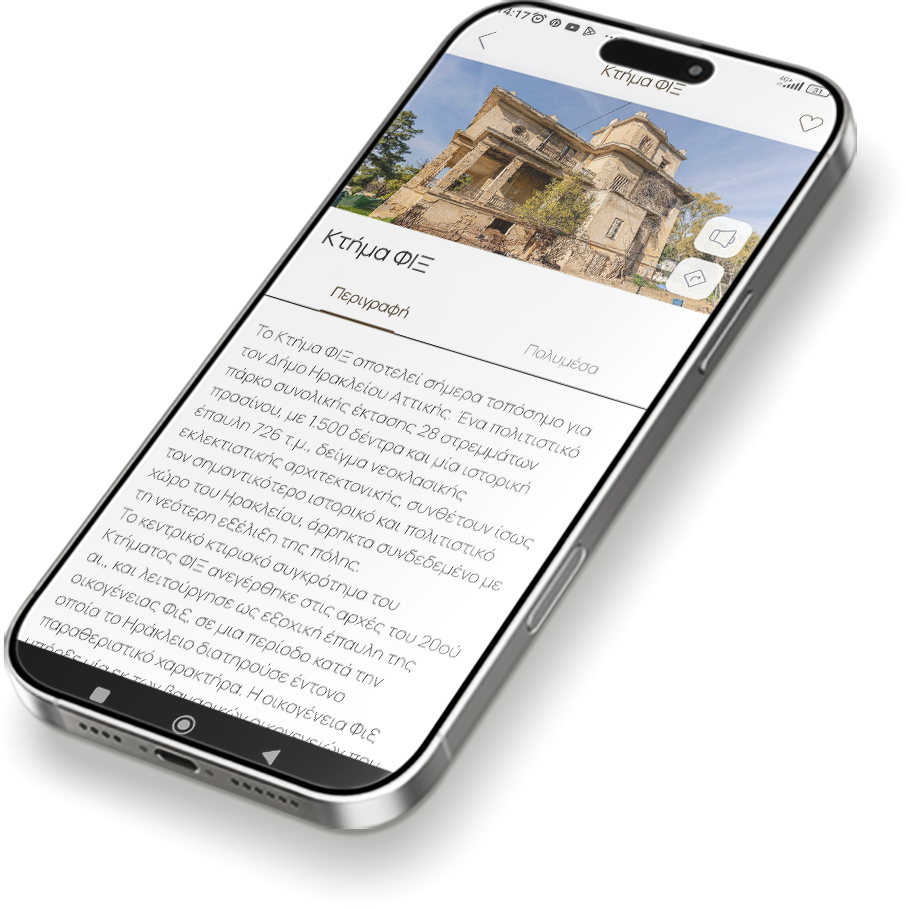
The Fix Estate covers an area of 27 acres within the boundaries of the Municipality of Heraklion, Attica, bordering the neighboring municipalities of Lykovrysi-Pefki and Metamorfosi.
Ο Δήμος Ηρακλείου γεννήθηκε σαν μικρή κοινότητα στην καρδιά της παλιάς Αττικής και μεγάλωσε σιγά-σιγά με τον καιρό έγινε ανεξάρτητος και δυνατός δήμος κρατώντας ζωντανές τις παραδόσεις του τόπου του πάντα συνδεδεμένος στενά με την Αθήνα και την ιστορία της
Ο Δήμος Ηρακλείου έχει ιστορία παλιά και πλούσια, ξεκίνησε ως μικρή κοινότητα στην Αττική αναπτύχθηκε, με τα χρόνια έγινε αυτόνομος και δυνατός δήμος, διατηρεί την παράδοση μαζί με σύγχρονη ζωή, συνδέεται στενά με την πόλη της Αθήνας καθημερινά.
First references on the area of Heraklion, Attica in Antiquity
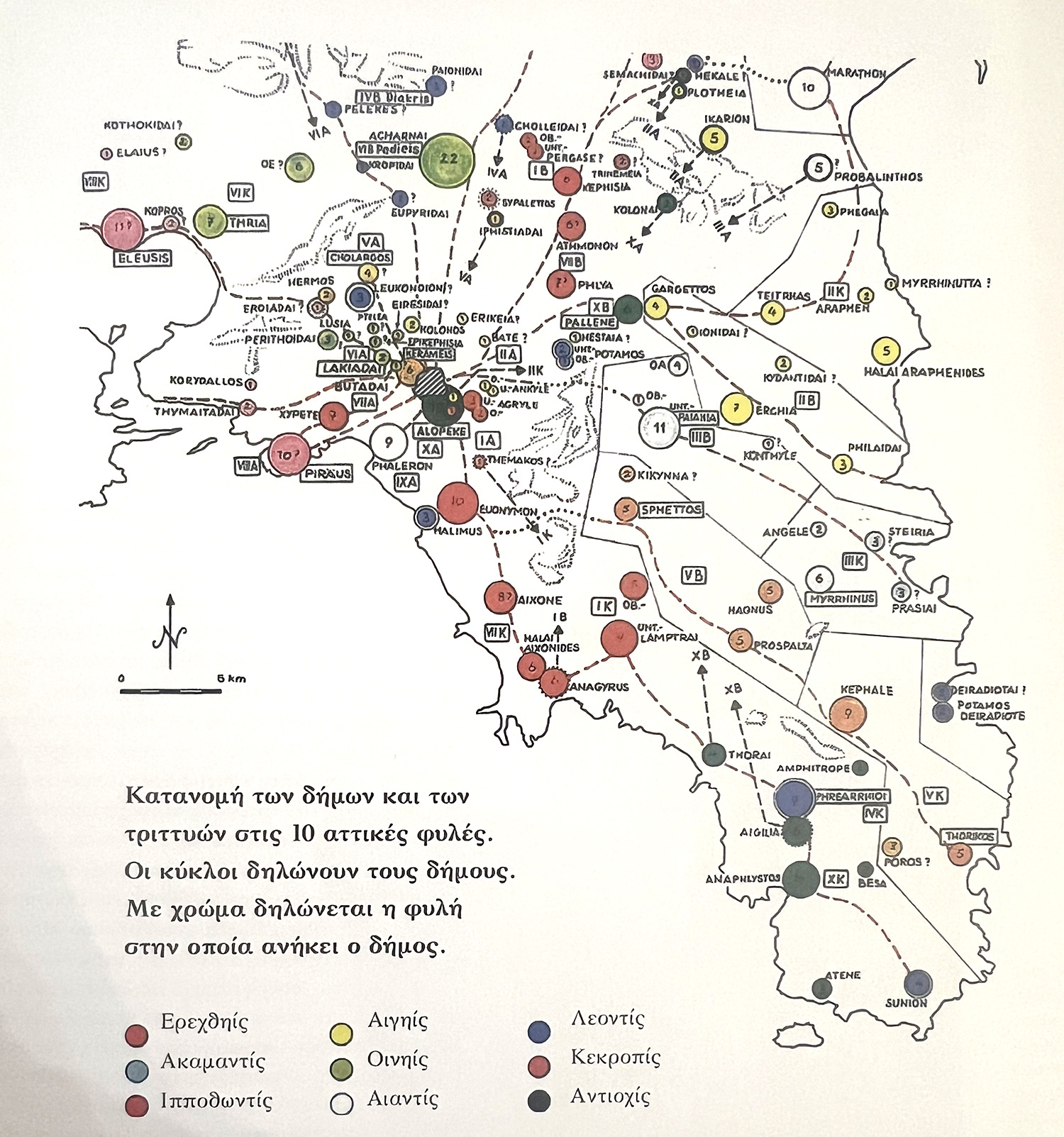
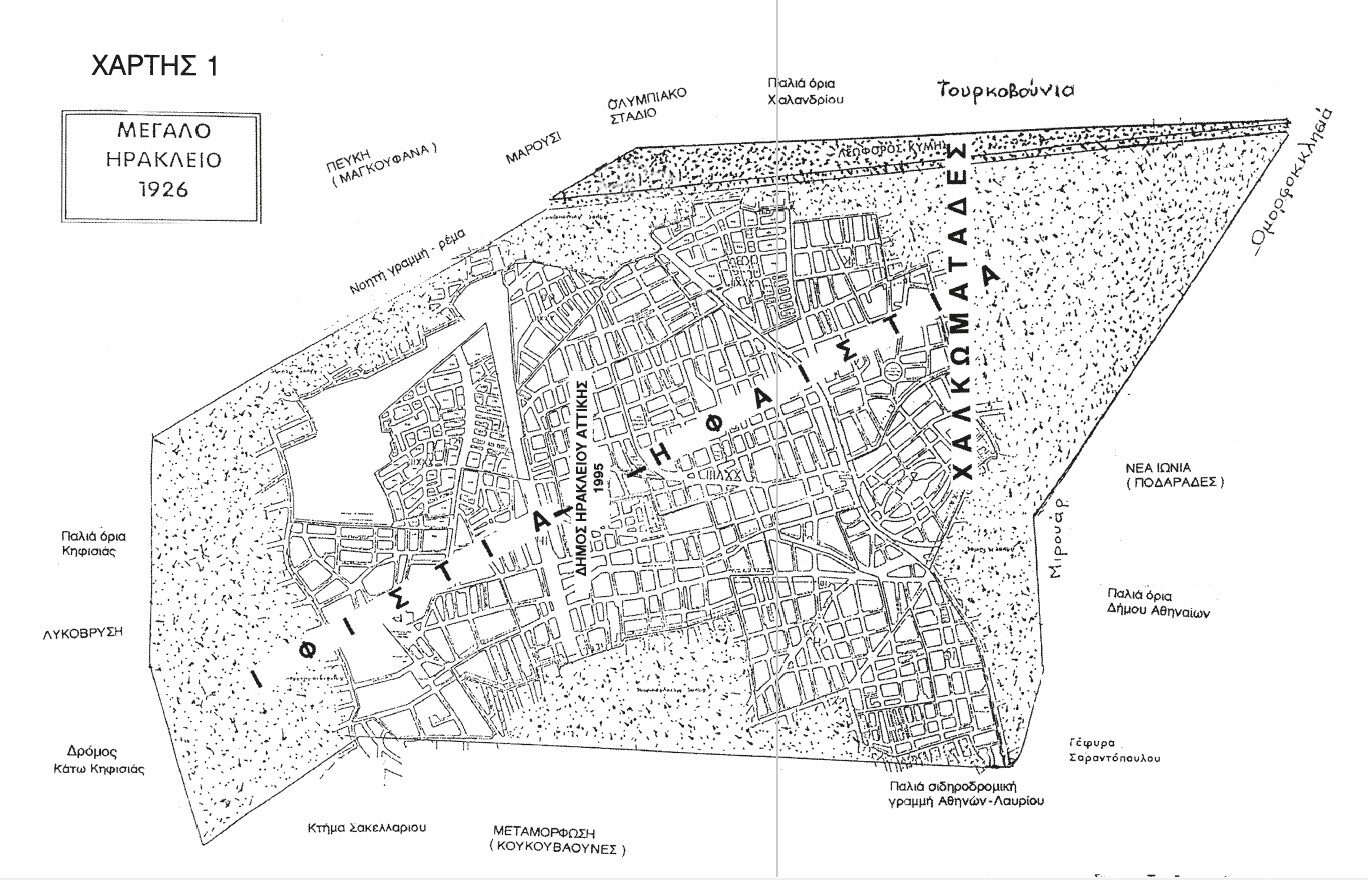
The earliest references to present-day Heraklion in Attica date back to classical antiquity. They are connected to the township of the Iphitidon or Hephaestiadon. It is assumed that ‘Hephaestion’ refers to a cultural and religious context within which human activity developed. The cult of Hephaestus was associated with productive activities in the area. The area was an agricultural space with cultivated lands and small residential hamlets.
2nd c. A.D.
Heraklion is fully incorporated in Roman Athens
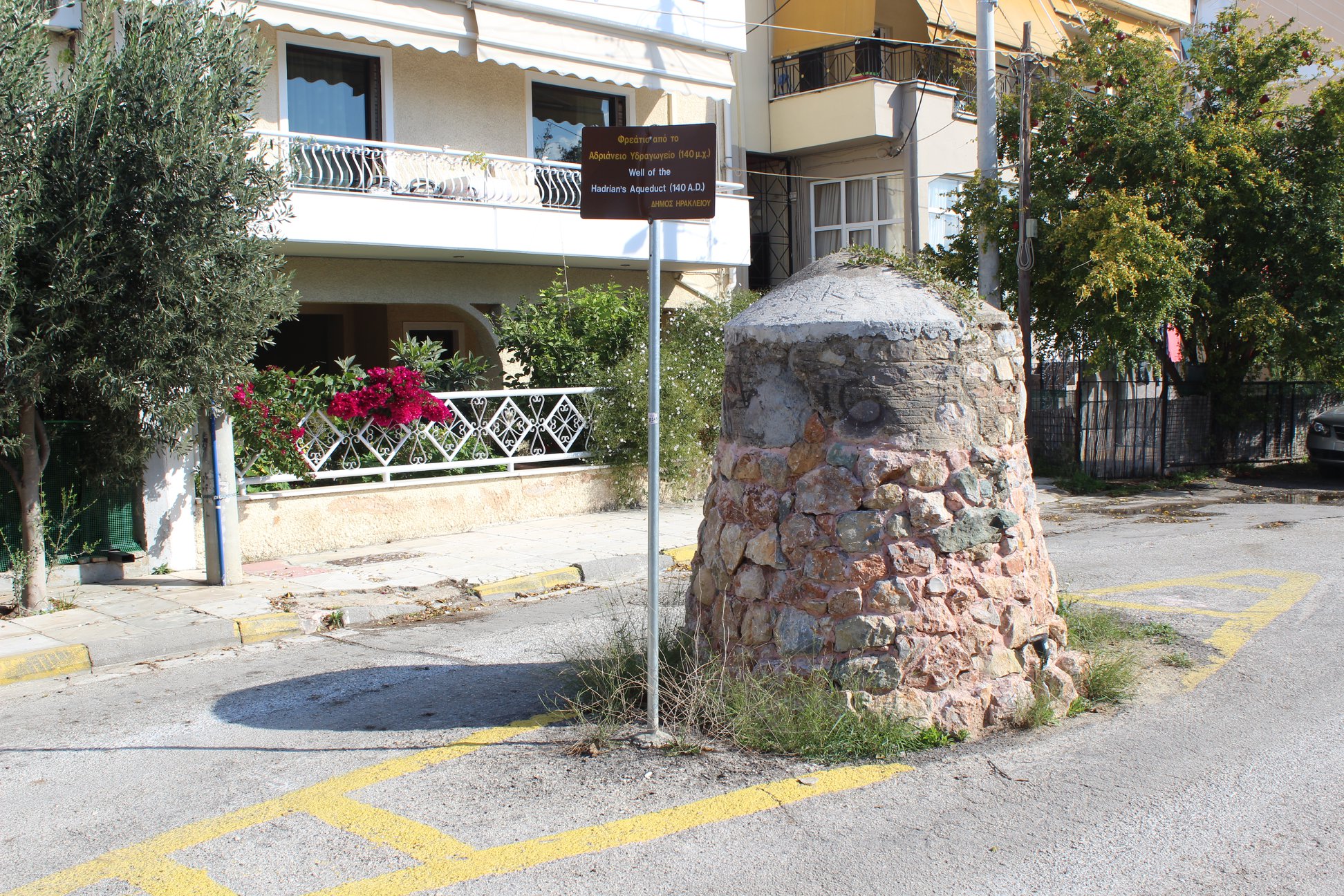
During the Roman period, the area of present-day Heraklion in Attica was fully incorporated into the administrative and technical system of Athens. Hadrian’s Aqueduct (2nd century AD), sections of which passed through the area, is undisputable proof. The aqueduct served as the main water supply system of Athens and highlighted the strategic importance of Heraklion in the infrastructure networks of the time.
View of remains from Hadrian’s Aqueduct today
/ 4th–12th c. A.D.
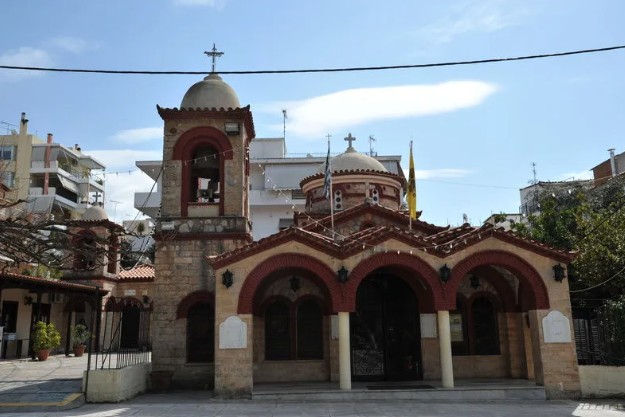
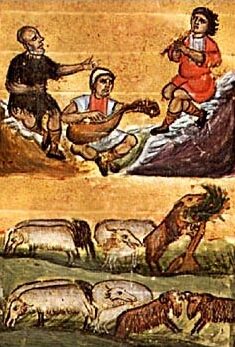
During the Byzantine era, Heraklion constituted of cultivable lands, small residential hamlets, and places of worship. A major landmark from those times is he Church of Saint George, which is associated with medieval religious tradition of the era.
Development of Heraklion as an agricultural settlement during the Byzantine era
/ 1204–1456
During the period of the Frankish Rule and after 1204, the area is incorporated into the Duchy of Athens. It retained its agricultural character and its religious status up until the Ottoman period.
Human presence continued uninterrupted, integrated into the rural and ecclesiastical landscape of medieval Athens, paving the way for the transition to the Ottoman period.
Heraklion is incorporated into the Duchy of Athens
/ 1456-1830
Ottoman period
More
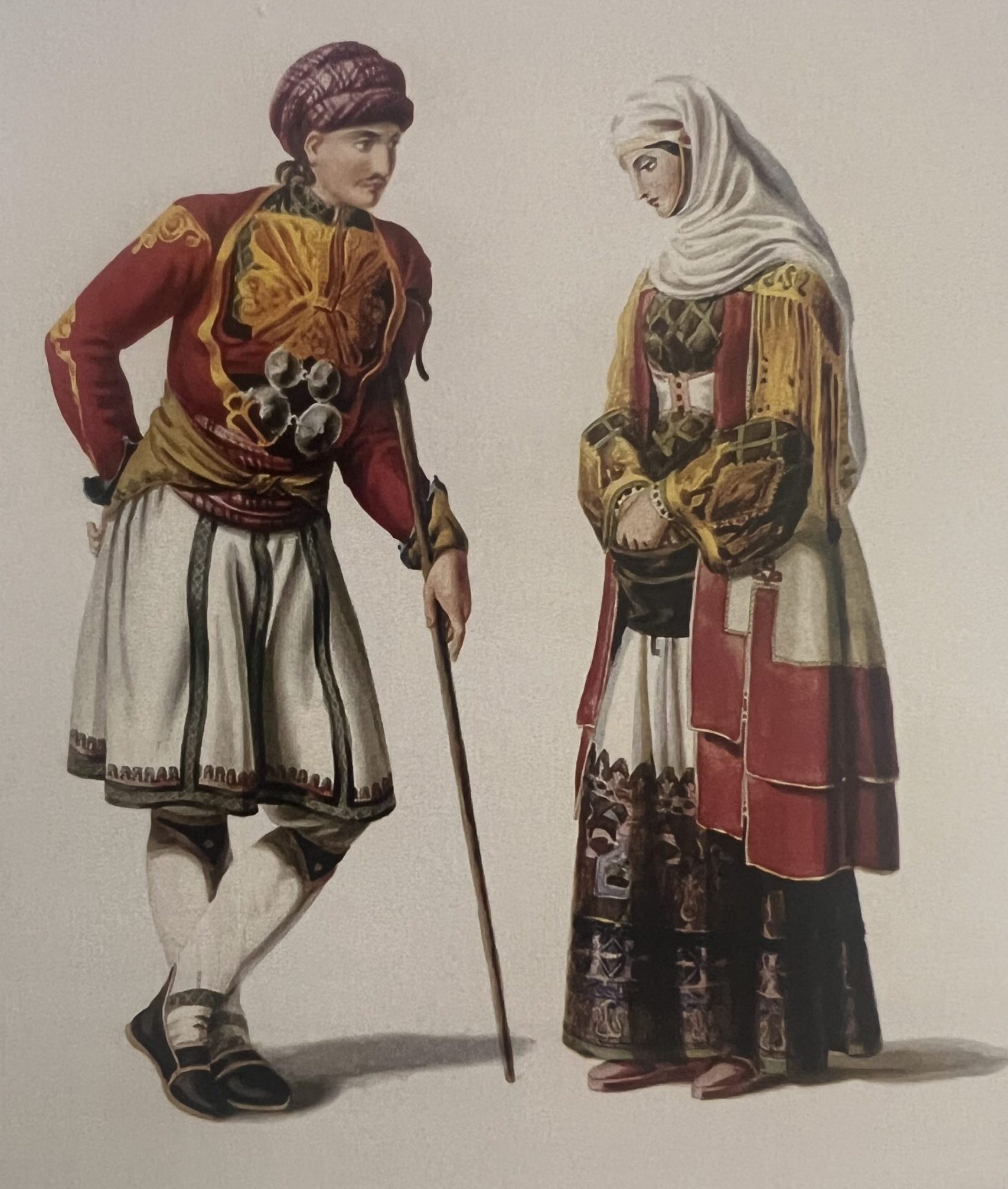
After 1456 the area is incorporated into the Ottoman administrative system as part of the of Athens kaza. It was called Arakli — derived from the ancient name Heraklion — at the time and retained its agricultural character. The armed conflicts of early 19th century and various epidemics led to a population decline.
/ 1833-1837
The Bavarian Military Colony is founded in Heraklion
More
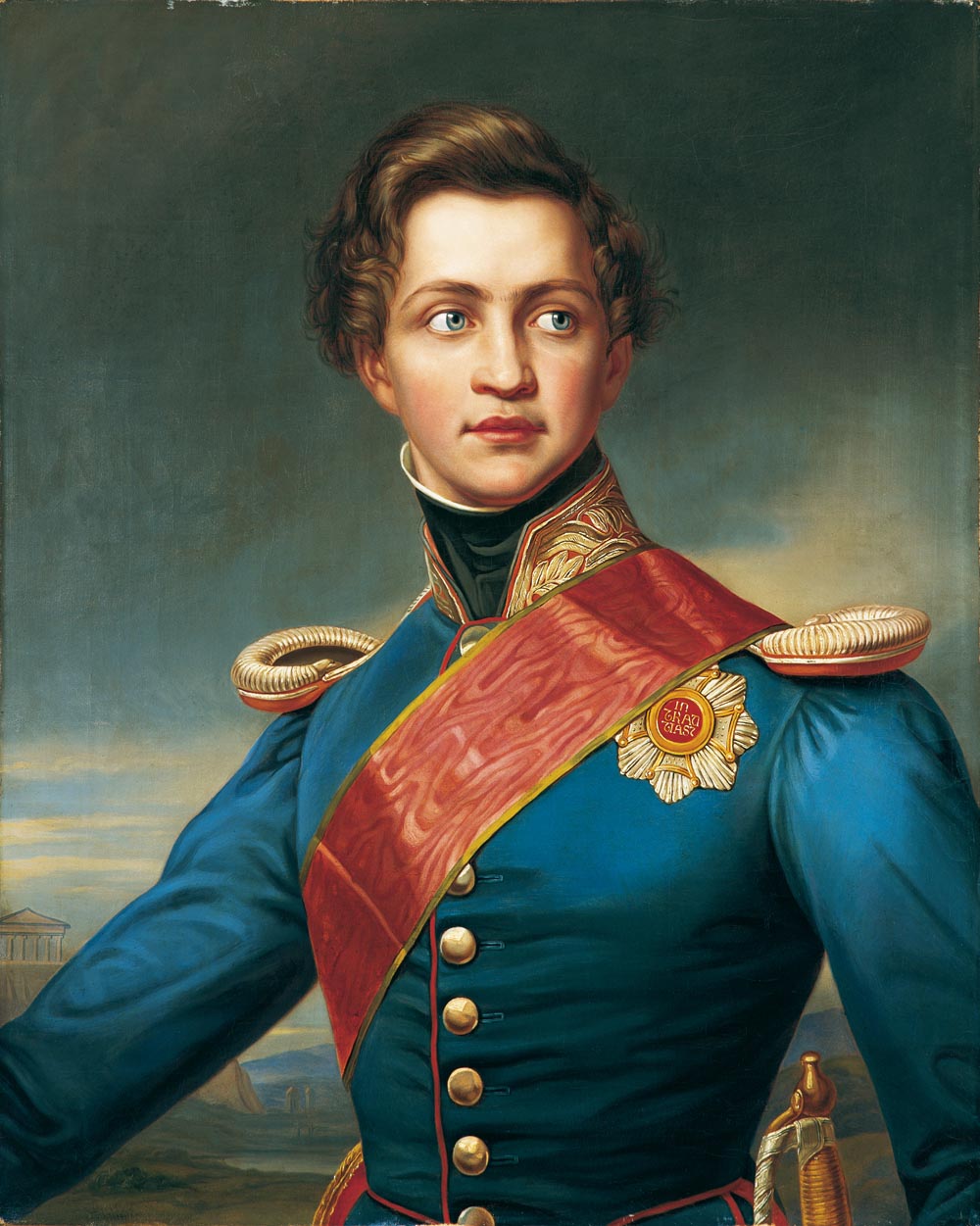
When the Bavarian prince Otto became the first King of Greece, a new era began for the newly founded Greek state. In May 1837, four Bavarian military officers — Neidel, Werner, Wuth, and Ziegler — submitted an official petition to King Otto requesting permission to settle permanently in Greece. Their petition marked the starting point for the founding of a Bavarian military colony in what was then the sparsely populated Heraklion.
/ 1835-1850
The settlement of the Fuchs family in Heraklion
More
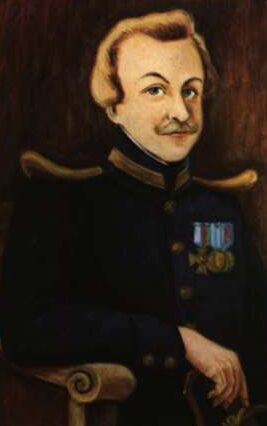
Georg Fuchs settled in Heraklion as a member of the Bavarian colony, thus establishing the presence of the Fix family in the area. His son Johannes Karl Fuchs was pivotal in the economic and social development of the area.
24 May & 11 June 1837
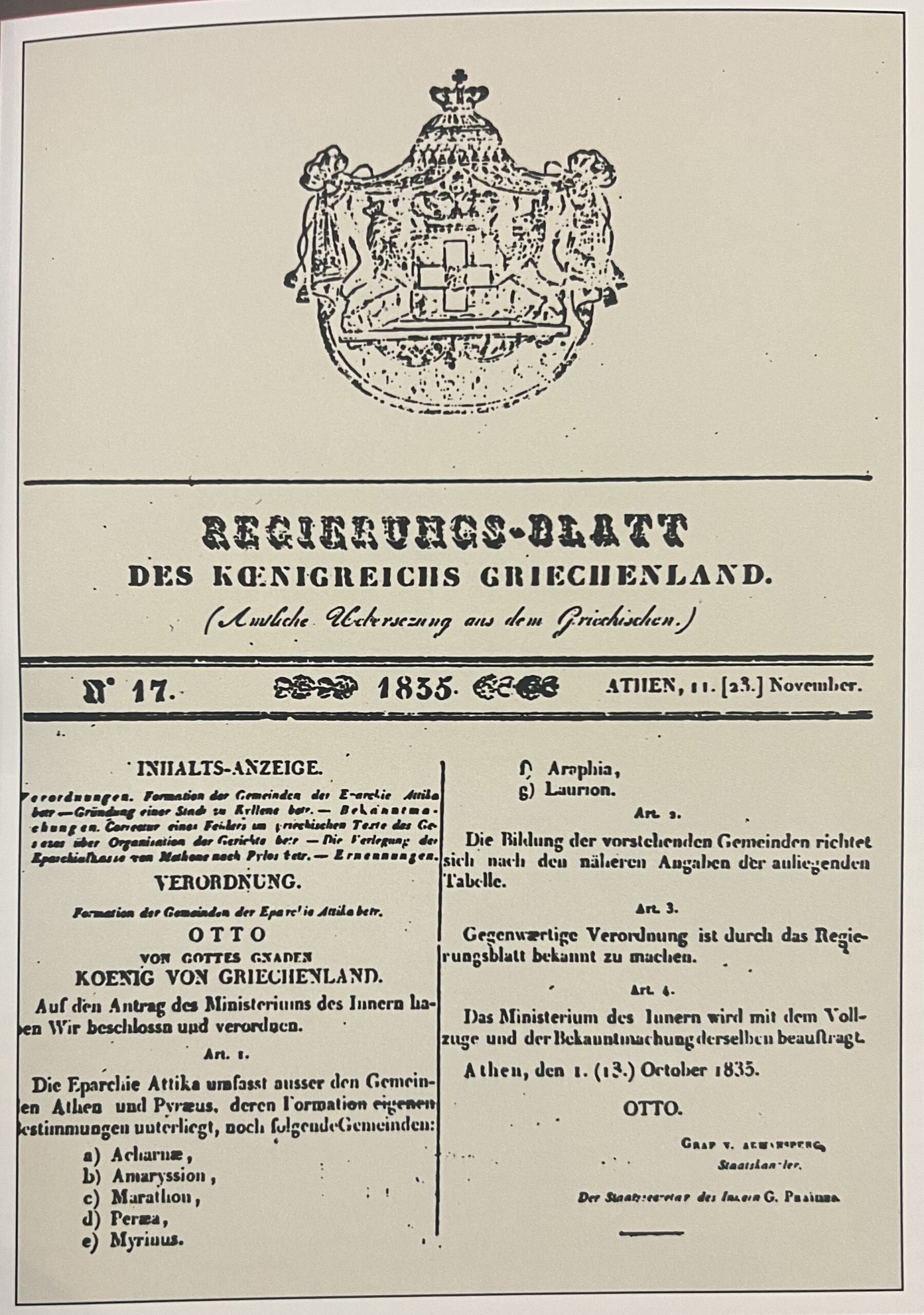
The founding of a military colony in Heraklion was made official by the Royal Decrees of May 24 and June 11, 1837. These decrees clearly regulated matters of land ownership and privileges for the new settlers, thus marking to the official founding of “Bavarian Heraklion.”
The Royal Decrees for the establishment of the military colony
More
The founding of a military colony in Heraklion was made official by the Royal Decrees of May 24 and June 11, 1837. These decrees clearly regulated matters of land ownership and privileges for the new settlers, thus marking to the official founding of “Bavarian Heraklion.”
19th century
/ 1837-1838
The first Land Registry in Greece
More
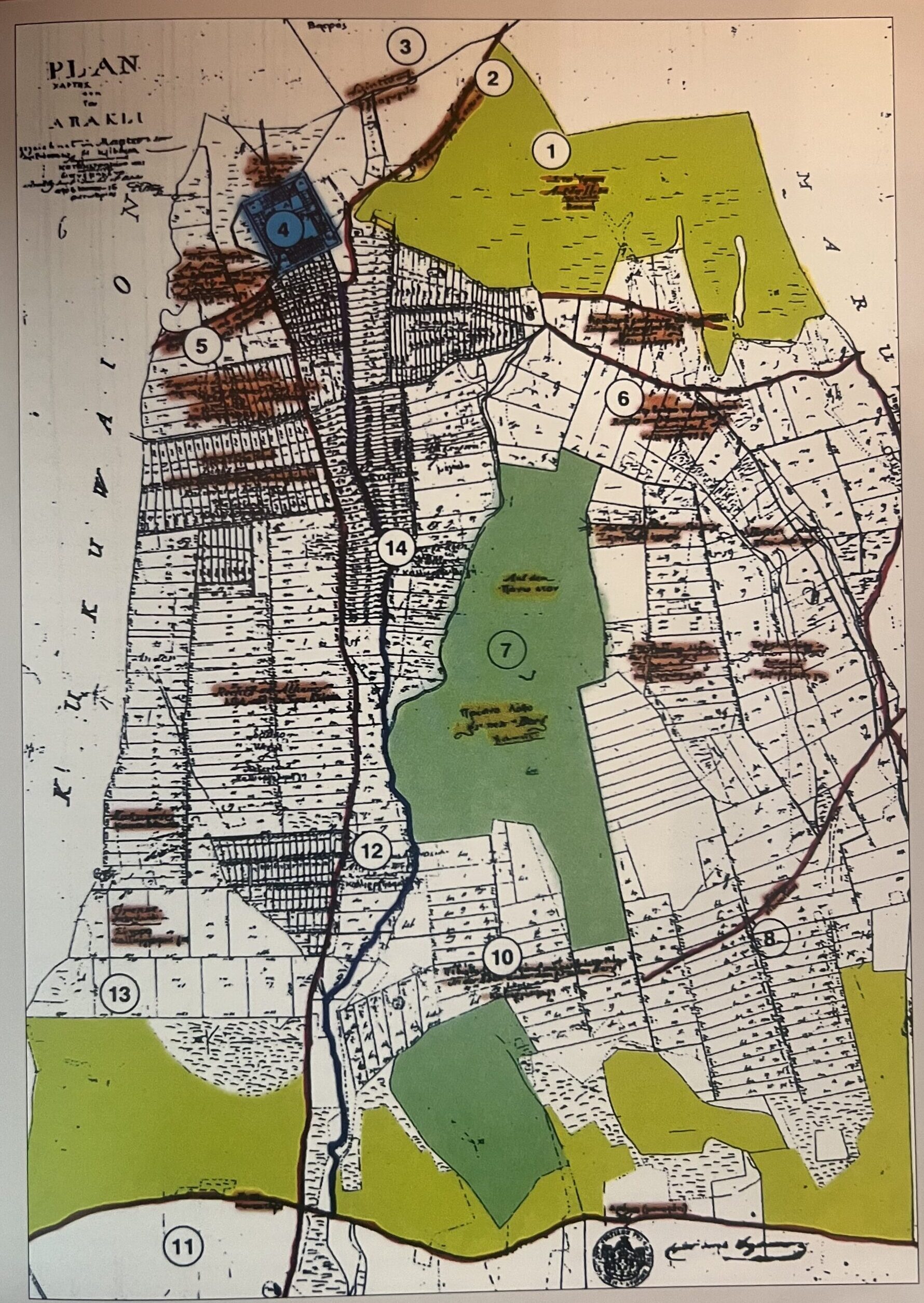
The first land registry in Greece was drawn up in Arakli, in the early years of Otto’s reign. The geometric survey was carried out by the surveyor corporal Bauer in 1837, at a scale of 1:4,000.
19th century
/ 1838-1843
Othonian administration decrees regarding the distribution of land and further development
More
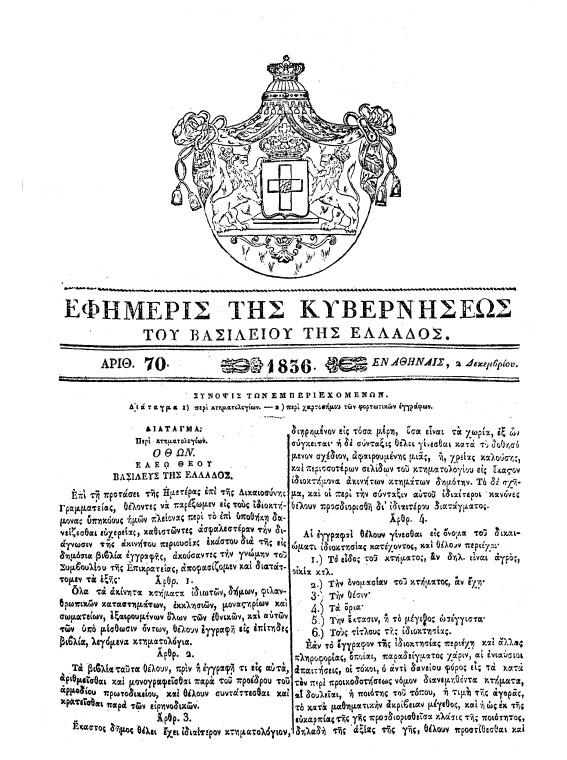
The Othonian administration showed particular interest in the Bavarian settlement of Heraklion, a fact reflected in the large number of decrees regulating the ownership status and distribution of land in Heraklion, as well as the construction of a road connecting the new residential area with Athens.
/ 1840-1843
Christoph Neeser: the first overseer of the Bavarian settlement founded a school and taught in it
More
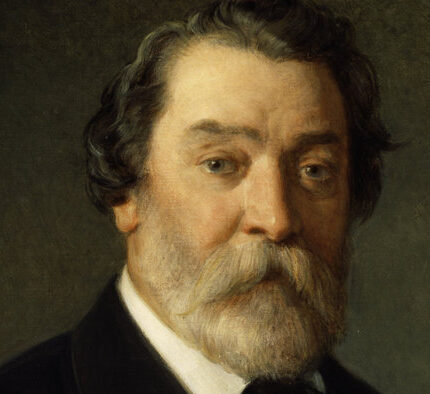
Johann Christoph Neeser (1808–1883) was the officer who received the keys to the Acropolis of Athens and became the first Guardian following the withdrawal of Ottoman forces, while he was also appointed the first overseer of the Bavarian settlement of Heraklion. In 1840, he proceeded to close the 12 taverns in a settlement inhabited by 3 single men and 15 families, and founded a school in which he himself taught, placing emphasis on education, social discipline, and agricultural self-sufficiency among the inhabitants.
/ 1842-1845
Construction of the Catholic Church of Saint Luke, designed by T. Hansen
More
The Catholic Church of Saint Luke was erected in 1842 – one of the most significant monuments of the Othonian period in Attica. It was completed in 1845, thanks to the close collaboration between King Otto and the Catholic Bishop of Greece, Joseph Blancis. The plot of land was granted by royal decree and the foundation stone was laid, underscoring the institutional role of the Catholic element in the new settlement. The Neo-Gothic church, designed by T. Hansen, remains a focal point of religious and social life to this day, making Heraklion the cradle of Catholicism in Attica.
/ 1858-1862
The first brewery in Greece opens in Heraklion
More
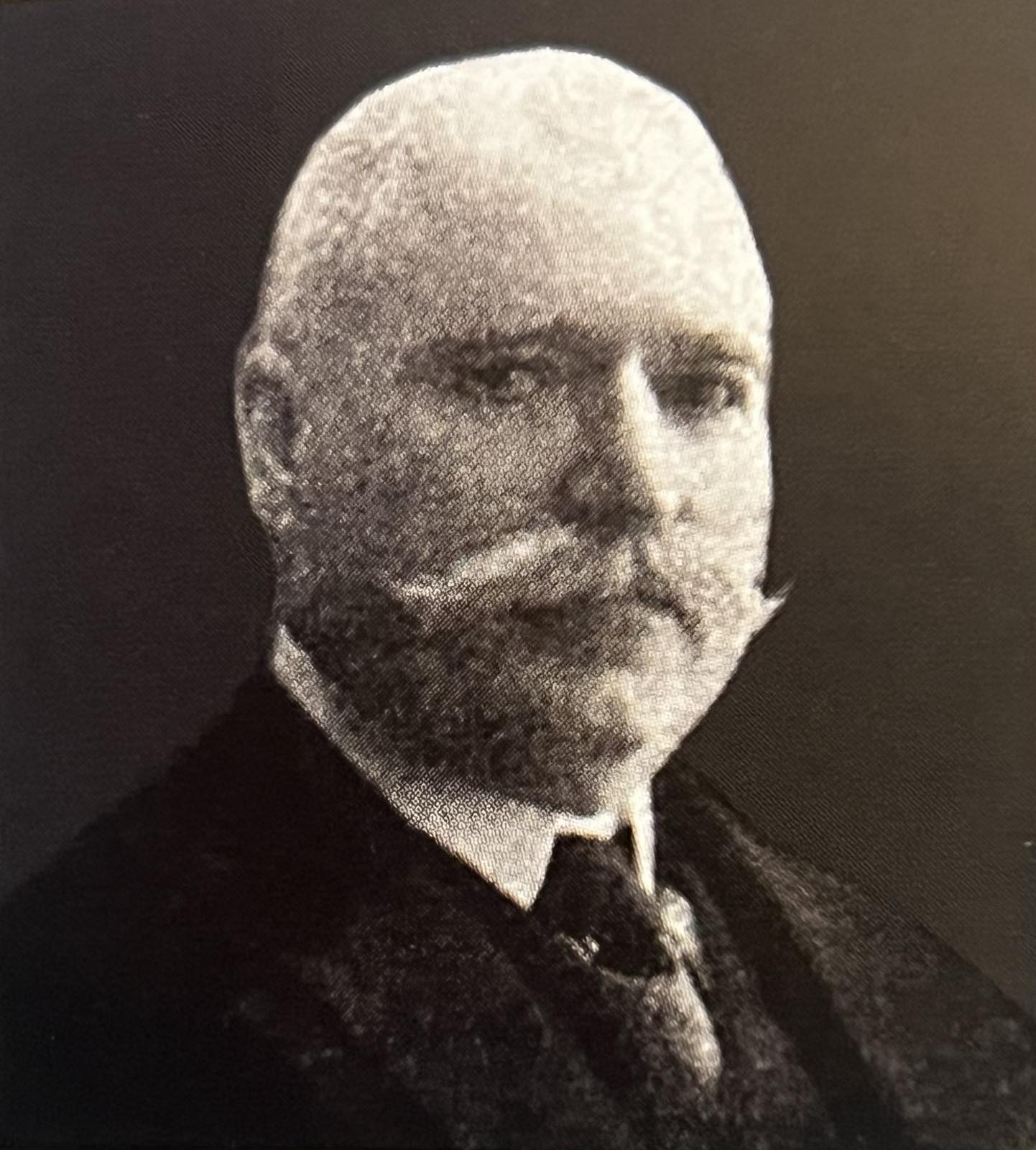
Johannes Karl Fuchs set up the first brewery in Greece in his courtyard, which survives to this day. The brewery also operated as a tavern, selling the beer it produced to the Bavarian officers residing in the area. Despite the very difficult economic situation in Greece, this business venture was highly successful, and the beer was in enormous demand, later also among Greeks. The first beer produced in the country naturally took the family name FIX. The Fix family held the monopoly on beer in Greece from 1864 to 1963.
/ 1858-1862
The assimilation of the Catholic Bavarians.
More
After the expulsion of Otto in 1862, the “Little Bavaria” settlement of Heraklion began to decline. Several families, out of the approximately 70 inhabitants, followed the dethroned King. Those who remained to maintain the settlement arranged marriages with Catholic families, mainly from Syros, resulting in the settlement of many Greek Catholic families from the Cyclades on the streets of Pindou, Dodekanisou, Androutsou, Moustakli, Alonion, and Plaputa.
/ 1885-1938
The “Beast” begins operation and links Heraklion to Athens
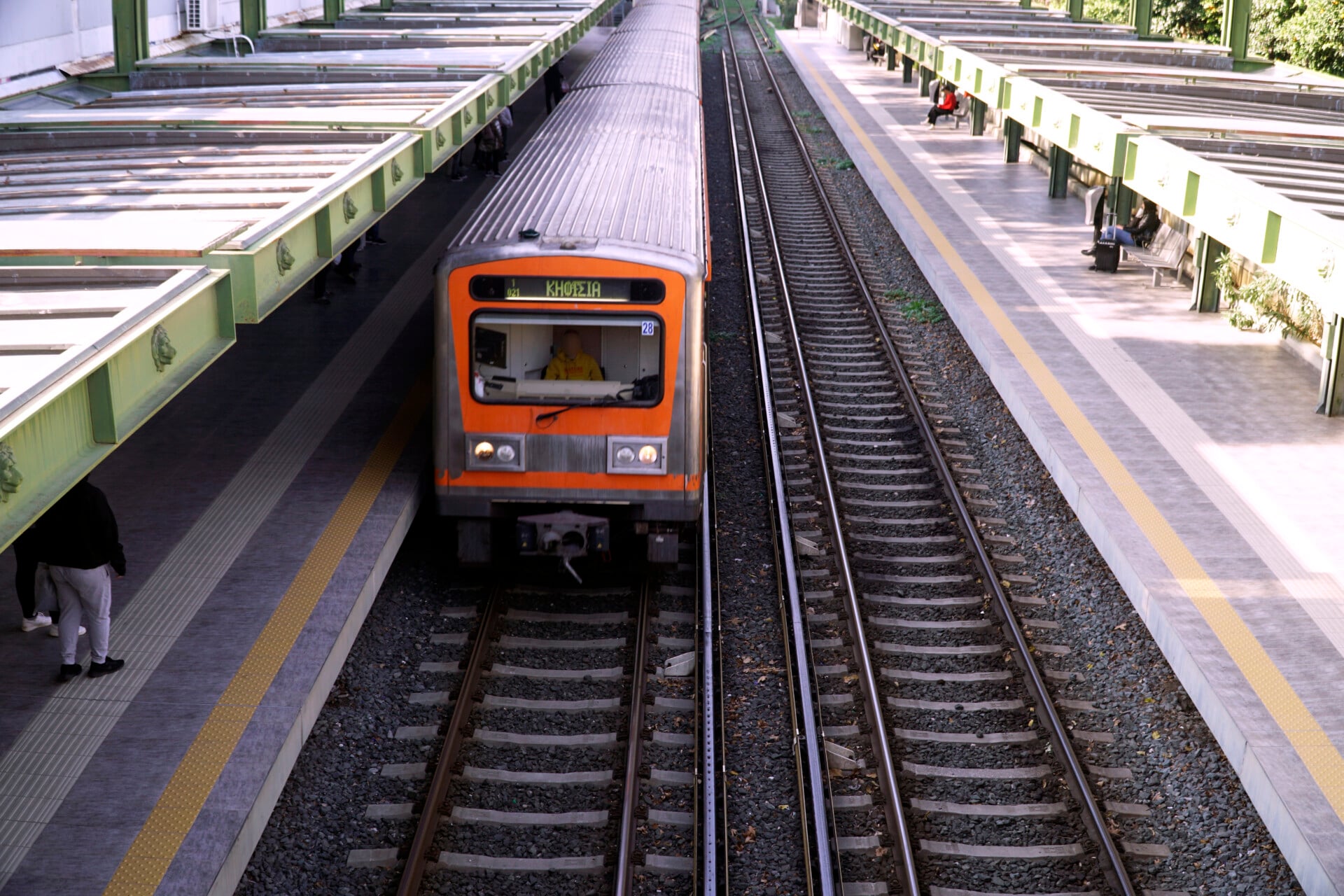
In 1885, the train called “The Beast” back then, operating on the Athens – Lavrion route, stopped in Heraklion thus reinforcing the connection of the area with Athens. The Beast operated until 1938.
/ 1912-1925
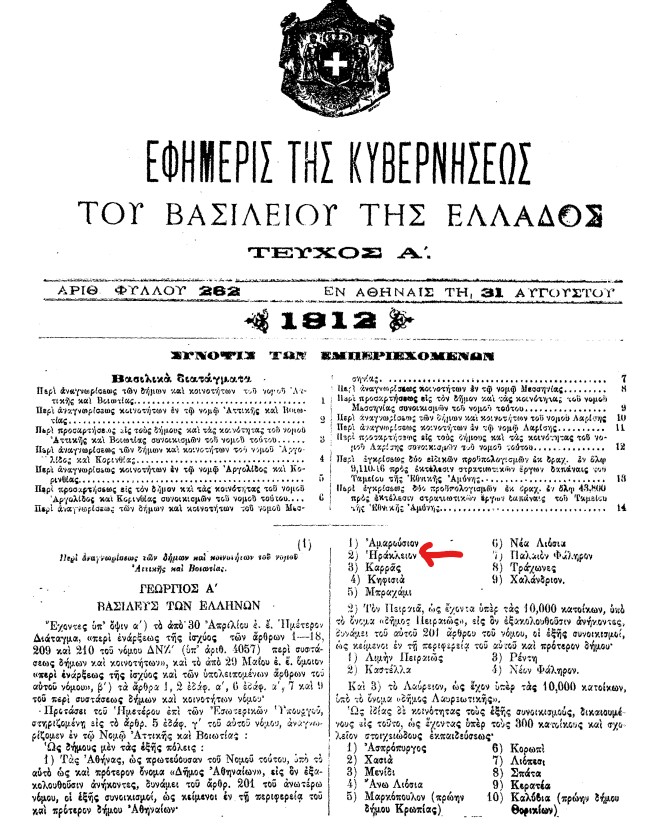
Heraklion, Attica, becomes anindependentcommunity
In 1912, Heraklion was administratively detached from the Municipality of Marousi and was declared a self-administered Community. In 1925, it was separated from the Municipality of Athens and became the independent Community of Heraklion, which also incorporated the area of Lykovrisi.
/ 1920-1930
Education and social organization
During the decade 1920–1930, the educational infrastructure of Heraklion is strengthened. New schools, cultural associations and community organizations are emerging rapidly. The 1st Primary School of Lower Heraklion was built in the early 1920s, while in the 1930s, the 2nd and 3rd Primary Schools operated temporarily in private facilities.
/ 1922–1935
The Asia Minor disaster and the wave of immigrants
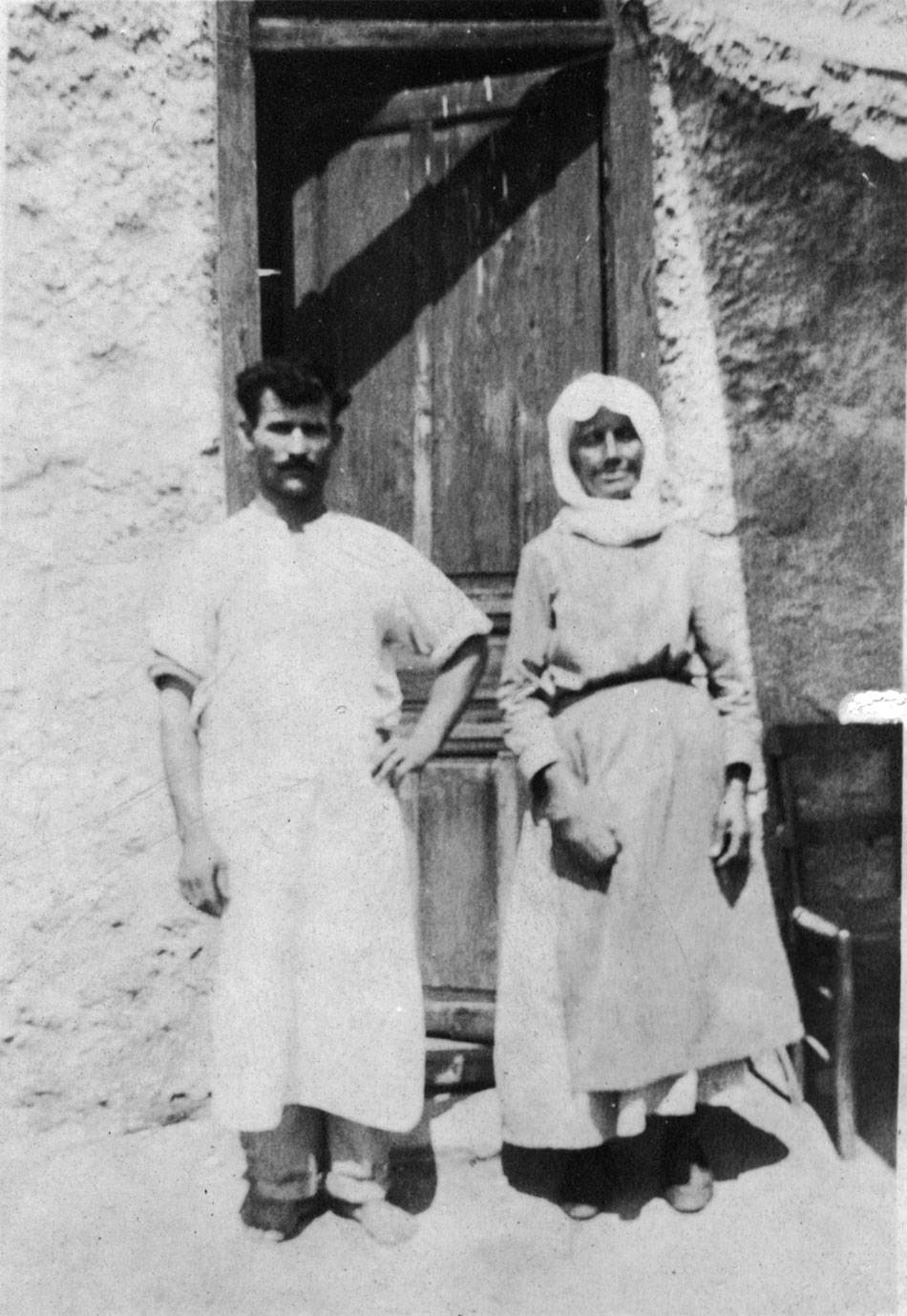
The mass settlement of approximately 2,500 Asia Minor refugees in Heraklion and its administrative territory, which until 1934 included Kalogrezа, Alsoupoli and Nea Ionia, altered the character/identity of the city. The newly arrived residents were housed temporarily in warehouses, schools, churches, and makeshift shacks.
/ 1923–1928
The organization of the refugee settlements
More
The organized resettlement of refugees began gradually through the work of the Refugee Settlement Commission and the assistance of private individuals and charity organizations, shaping the new urban fabric of the city. Refugee neighborhoods were established primarily in the broader areas of Podarades and Kalogrezа, with makeshift structures which transformed the spatial and social organization of the city.
The organized resettlement of refugees began gradually through the work of the Refugee Settlement Commission and the assistance of private individuals and charity organizations.
The refugee influx and the reshaping of Heraklion
/ 1928
A developing suburb
More
By 1928, Heraklion in Attica, with a population of 3,000 residents, ranked among the largest settlements in the greater Athens area, thanks to operation of the railway, the refugee settlement, the gradual formation of new neighborhoods.
/ 1935
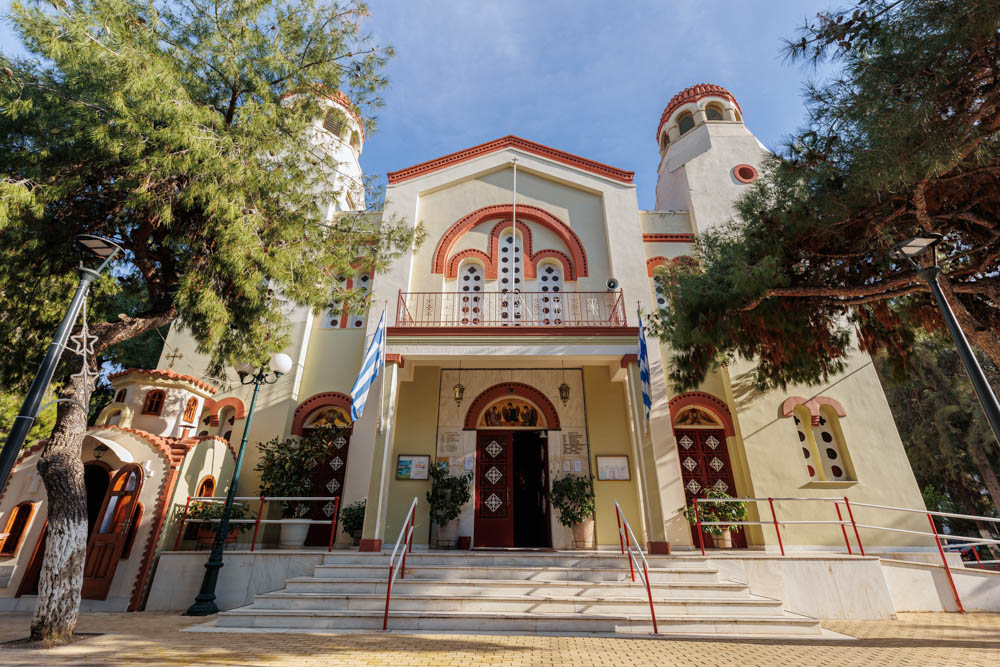
In 1935, a new and larger church was erected on the site of the old Church of Saint George, reflecting the population and spiritual growth of the area.
Saint George church as the symbol of refugee memory and postwar society
More
In 1935, a new and larger church was erected on the site of the old Church of Saint George, reflecting the population and spiritual growth of the area. In 1958, the church was decorated with frescoes by Fotis Kontoglou and his students, connecting Heraklion with the artistic and intellectual current of the post-Byzantine renaissance. This work remains to this day a cultural statement, embodying the memory of the refugees and the collective identity of postwar society.
/ 1938
In 1938, the construction of the Church of the Holy Trinity was completed, having begun back in 1920. The church constitutes one of the most significant religious and social landmarks of the area, as it had served as a place of gathering and everyday life from its earliest years..
Holy Trinity church and public space
/ 1936-1940
After 1936, Heraklion in Attica had become established as a suburb of Athens. The neighborhoods formed during the previous decades operated in an organized way, while daily life revolved around the railway station, schools, churches and public spaces. Kalogreza and Alsoupoli gathered a significant working population connected with the lignite mines and small-scale industry. Despite the authoritarian political context of the era, a society with strong neighborhood ties and cohesion gradually took shape.
Stabilization and social maturation
/1938-1958
In 1938, the first drillings began in Heraklion, around the intersection of Kymis and Antypa streets, leading to the discovery of lignite coal mines.
The entrance to the mine in Kymi. Wood engraving by H. Clerget after a drawing by H. Belle (Le Tour du Monde 32/1876, p. 80)
Lignite mines in Heraklion
More
In 1938, the first drillings began in Heraklion, around the intersection of Kymis and Antypa streets, leading to the discovery of lignite coal mines. The first owners were the Chiot shipowners Michalinos–Michalos and Apostolos Kiouzes-Pezas, who leased the lignite mines of Neon Heraklion in 1940. The Heraklion coal mines supplied the coal needs of the Electric Company, the Keratsini power generation plant, and the Gas Company.
/1941
Greece’s entry into WWII in 1940 changed daily life in Heraklion.
At the threshold of war
More
Greece’s entry into WWII in 1940, changed daily life in Heraklion. Men were drafted and departed from the railway station, while families faced insecurity and shortages. The working-class neighborhoods of Kalogrezа and the refugee districts were hit particularly hard, as employment diminished and survival became increasingly difficult.
In 1941, following the arrival of German forces in Attica, Heraklion, Attica came under Occupation. The strong neighbourhood ties, the working-class character of the area, and the refugee experiences of previous decades shaped the social foundations upon which the Resistance movement would later develop.
/1941-1944
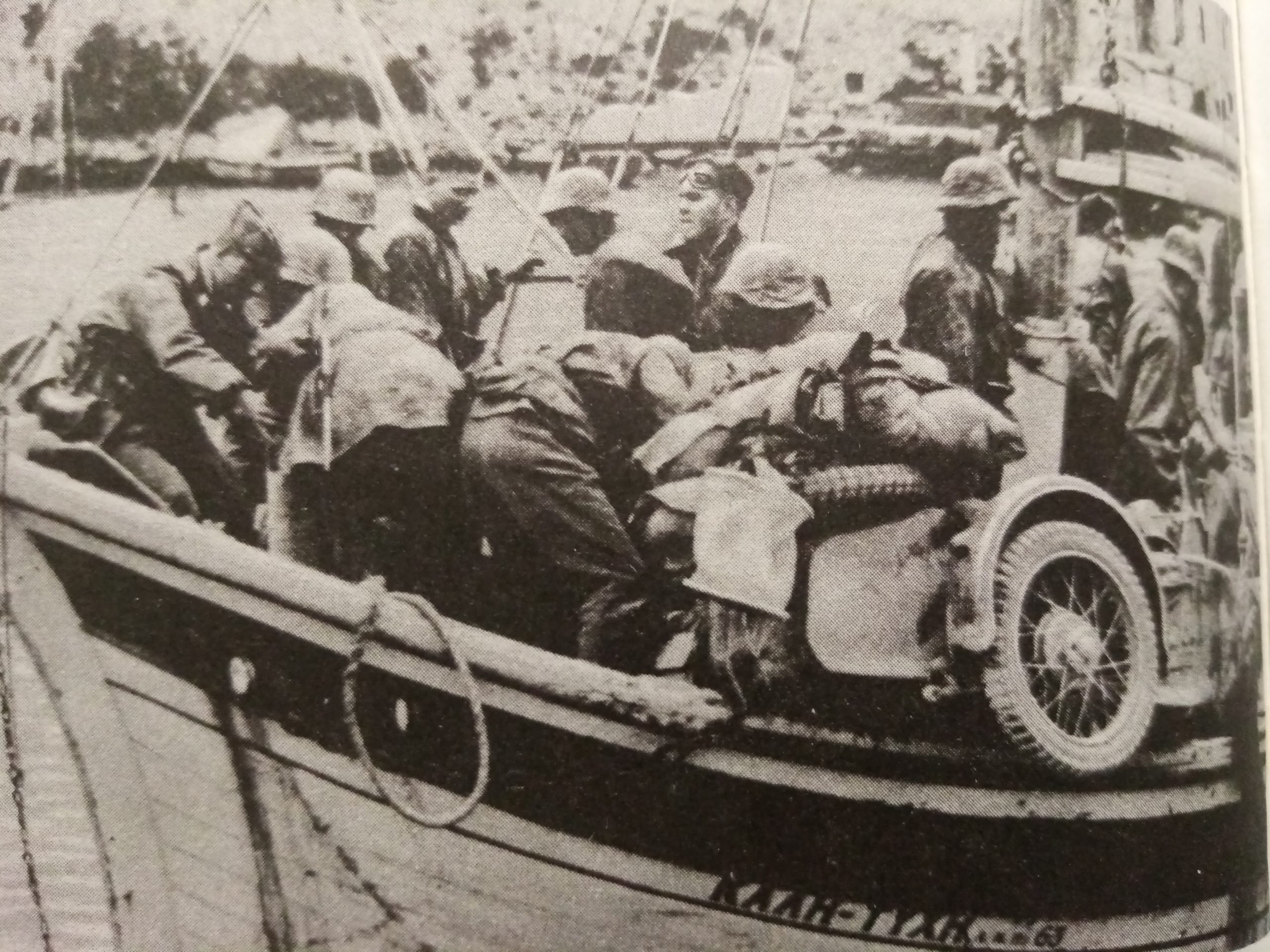
During the Nazi occupation, Heraklion was turned into a military controlled zone. A large area in the center of the town was fenced with barbed wire, and trenches with sloping walls were constructed so that German vehicles and fuel depots would not be easily visible from aircraft.
German Occupation and Resistance
More
Heraklion was surrounded by extensive barbed-wire fencing, forming a controlled military zone with checkpoints and fortified positions.
/1941-1944
The people of Heraklion in the Resistance
More
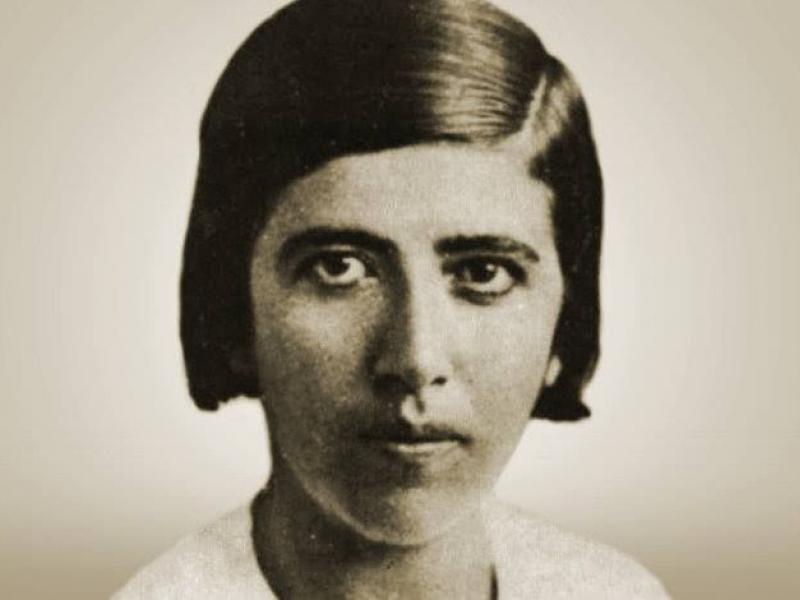
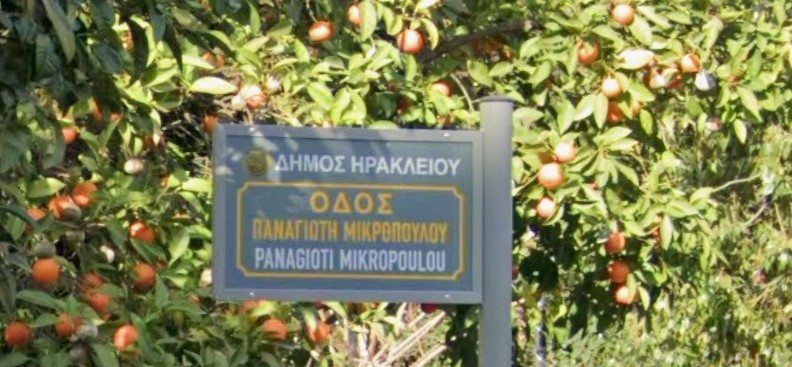
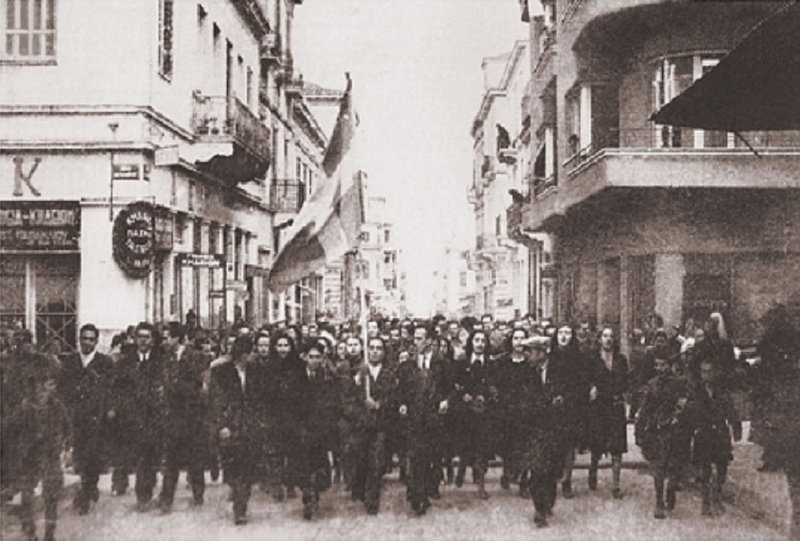
During the Nazi occupation, Heraklion was turned into a military controlled zone. For this purpose, a large area in the center of the town was fenced with barbed wire, and inside it trenches with sloping walls were constructed so that German vehicles and fuel depots would not be easily visible from allied aircraft. The perimeter fencing extended from Anamorfoseos Street to the hill of Agia Triada, Oraiopoulou Street, Othonos Square, Philotheis Street, and the Green Hill. Heraklion contributed greatly in the National Resistance. Electra Apostolou, Panagiotis Mikropoulos, Yiannis Bobotinos and Kosta Oraiopoulos stand as timeless symbols in the struggle for freedom.
/1944
The residents of Heraklion in the Kalogreza Blockade
More
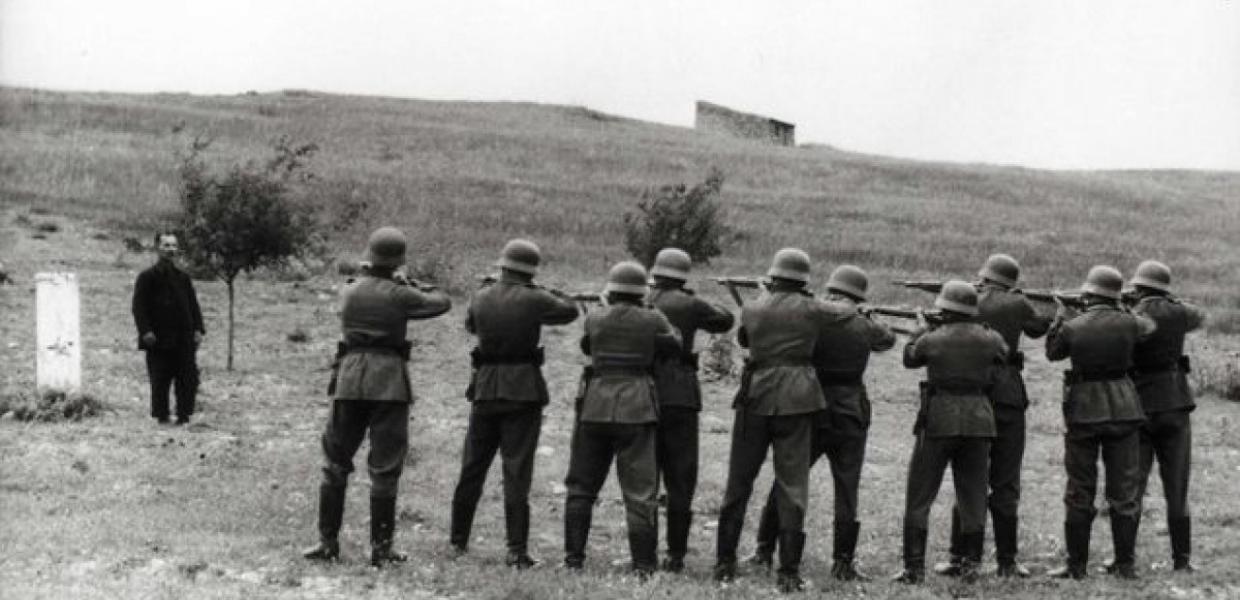
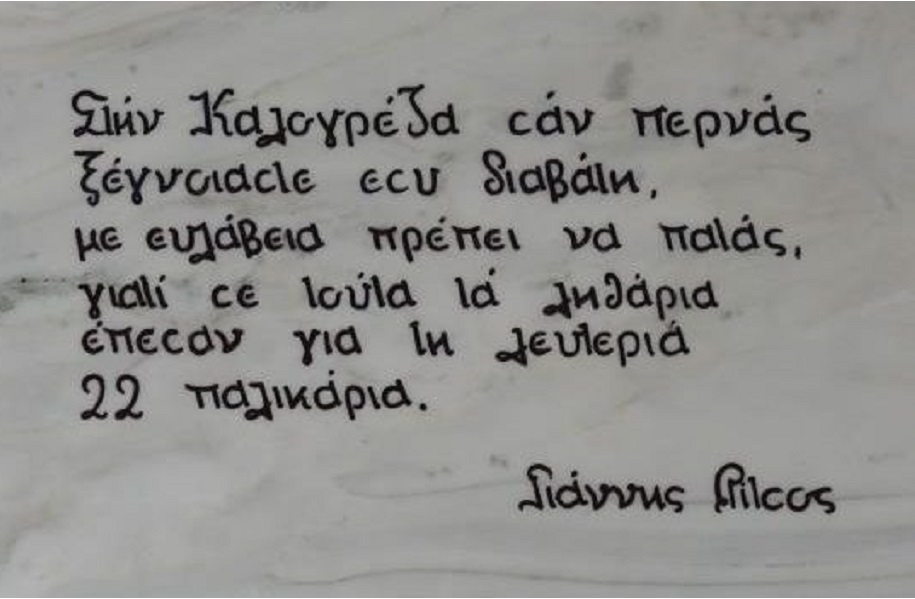
March 15, 1944 was carved as one of the darkest and most tragic moments of the Occupation. The Kalogrezа Blockade, with its mass arrests, brutal torture, and the execution of 22 resistance fighters, left an indelible mark on the memory of Heraklion. Many residents of Heraklion found themselves on the front lines of the Resistance and paid with their lives the struggle for freedom. This event remains to this day a powerful symbol of sacrifice, collective action, and historical memory.
/1948
Heraklion, Attica declared a Municipality
More
After the war, the Occupation, and the Civil War — which caused enormous destruction throughout the Greek provinces — Heraklion, like other areas of Athens, received new inhabitants from various parts of Greece. On November 27, 1948, due to rapid population growth, the Community of Heraklion was officially declared a Municipality. This had been preceded by the abolition of the settlement of Ano Heraklion on October 16, 1940, and the incorporation of the Community into the Region of Attica on July 26, 1943.
/1951-1981
Rapid growth of the population
From 1951 to 1981, the population of Heraklion grew very rapidly, almost doubling every ten years.
More
Heraklion is transformed into a large urban hub. The new residents came from various regions of Greece, including the Peloponnese, Epirus, Crete, Serres, Roumeli, Thessaly, and other areas. People from Epirus settle in Old Heraklion and their neighborhood is named “Ipirotika,” while those from Crete settle mainly in the Kato Psalidi area.
/1957 -1972
Infrastructure: the road to urban development
More
In 1957, the train station reopened, this time connecting Heraklion not only with Athens but also with Piraeus. The connection boosted residential development.
/1964-1983
Development of the city’s cultural environment
More
From the 1960s onward, the cultural life of Heraklion developed significantly. In 1964, the Municipal Library and a small municipal band were founded, laying the first foundations of cultural activity. From 1978, the Municipality’s Film Club operated, initially at the “Anoixis” cinema and later at the “Anna-Maria.” In the early 1980s, the Municipal Theater Stage was created, from which new theater groups emerged. This was followed by the founding of the Municipal Orchestra in 1982 and the Municipal Choir in 1983. In 1987, the Municipal Cinema “Nostalgia” began operating, while toward the end of the 1980s the Municipal Radio Station “Epikoinonia” was established, further enriching the city’s cultural expression.
People of Heraklion
Μανόλης Αναγνωστάκης
Ο Μανόλης Αναγνωστάκης (1925-2005) γεννήθηκε στη Θεσσαλονίκη. Σπούδασε ιατρική και ειδικεύτηκε ως ακτινολόγος στη Βιέννη (1955-1956). Άσκησε το επάγγελμα του ακτινολόγου στη Θεσσαλονίκη και το 1978 μετεγκαταστάθηκε στην Αθήνα. Για την πολιτική του δράση στο φοιτητικό κίνημα φυλακίστηκε στο διάστημα 1948-1951, ενώ το 1949 καταδικάστηκε σε θάνατο από έκτακτο στρατοδικείο. Εμφανίστηκε στα γράμματα νεότατος, στη διάρκεια της Κατοχής, στο περιοδικό “Πειραϊκά Γράμματα” (1942) και στο φοιτητικό περιοδικό “Ξεκίνημα” (1944). Του τελευταίου περιοδικού διετέλεσε και αρχισυντάκτης, από το τεύχος 1 (15 Φεβρ. 1944) μέχρι και το 11-12 (1 και 15 Οκτ. 1944). Δημοσίευσε ποιήματα και κριτικά σημειώματα σε πολλά περιοδικά, ενώ είχε πυκνή παρουσία στην εφημερίδα “Αυγή”, με κείμενα για θέματα λογοτεχνικά και πολιτικά.
Cities are built with stone;
identities with memory
Discover the Digital Archive
Photos
Church interiors
HERAKLION, ATTICA
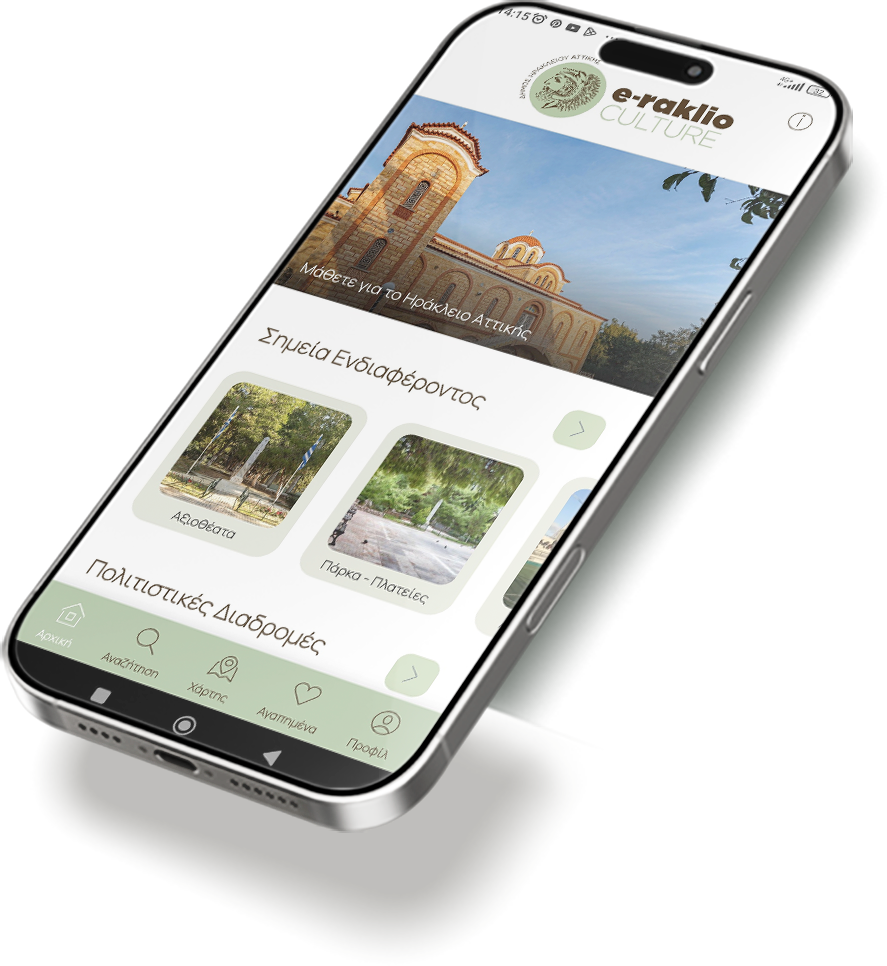
Discover Heraklion in Attica through our app! The app offers a comprehensive tour of the city of Heraklion in Attica, combining information, images, and an interactive map. Explore its landmarks, points of interest, and cultural venues; learn about the history and life in the city, and plan your own discovery route. Experience a unique way of getting to know Heraklion, Attica — where the past meets the present, through technology.
Available on Android & iOS
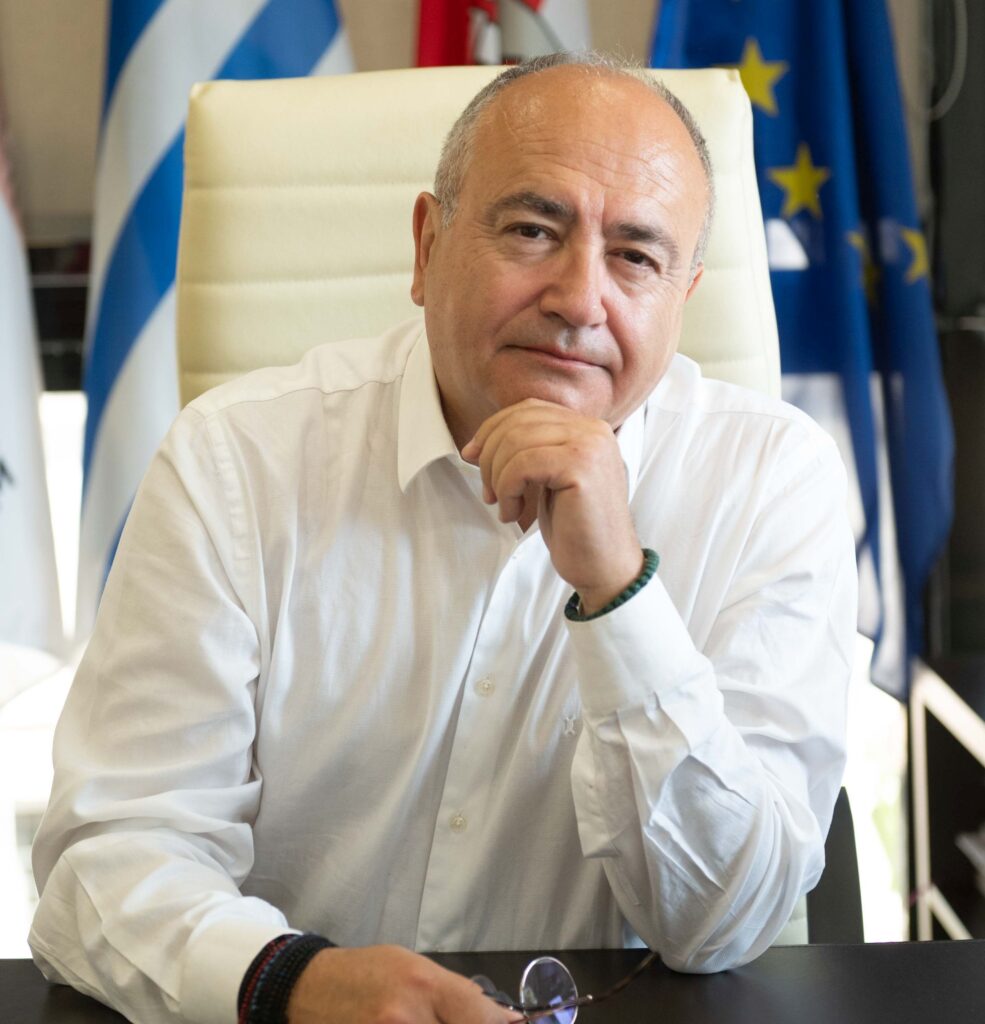
Guided by our history and driven by innovation, we are shaping the Heraklion of tomorrow. e-raklio Culture is one more step in the digital transformation of our Municipality, showcasing our cultural wealth and strengthening the outward reach of Heraklion, Attica. We continue to invest in initiatives and innovative projects that focus on our people. I welcome you to this new digital journey through our city.
Nikos Bambalos
Mayor
e-raklio Culture is an open invitation to rediscover our city through a modern digital guide, where our cultural identity becomes accessible to all. I invite you to explore and discover Heraklion in Attica, its neighborhoods and its people, through a new and dynamic digital experience.
Emilia Tziva
Deputy Mayor for Digital Policy, E-Governance & European Programs
Culture is the living soul of our city, nurturing creativity, expression, and human connection. By preserving and promoting our cultural heritage, we honor our commitment to a society that respects and promotes its rich legacy. Through shared vision and collective action, we can shape a vibrant cultural landscape that will inspire future generations and strengthen the identity of the Greek people. Honoring our roots, we move forward together toward the future.
Katerina Zagana
City Councillor with overall supervision and coordination of Culture and Public Relations